
Vegetables account for 5.44 per cent of the Consumer Price Index.

The Centre has decided to create a buffer stock of 350,000 tonnes.

The forthcoming Budget is likely to make a provision of Rs 64,000 crore (Rs 640 billion) for the Mahatma Gandhi National Rural Employment Guarantee Scheme in 2011-12, against Rs 40,100 crore (Rs 401 billion) in the current fiscal.
Is the general increase in price rise affecting you? has your monthly budget gone for a toss? How are you coping with increase in prices of essential goods of daily use? Share your views with us.

Total debt for listed Indian companies excluding financials fell only 4 per cent to $368 billion in the year ended in March 2015.

India is among the three least-favoured Asian stock markets, according to BofA Securities whose survey found that 10 per cent of fund managers are underweight on Indian equities from a 12-month perspective.

The statistics ministry has proposed the new base year for GDP and IIP as 2017-18 while for CPI it will be 2018.

Deflation masked the rise in food inflation to a 5-month high.

The earlier high was in January this year at 5.07 per cent.

PMO being sent daily updates on food cost situation in four major metropolitan cities to ensure no unusual flare-up.

Automobile, apparel and electronics are among sectors that see a sales boost during the festival season, a time when investors expect gains in related stocks. This year could be different: Analysts have factored in all positives and do not expect such stocks to deliver lucrative returns. "Indian households spend across sectors like automobiles, consumer durables, and consumer staples during the festival season.

Indian equity markets should be able to withstand inflation up to 8 per cent, said analysts at Credit Suisse Wealth Management in a recent note. Should the rate of inflation move higher than this, the valuation of Indian equities could deteriorate further, they cautioned. The fall from the peak levels has seen Nifty's 12-month forward price-to-earnings (P/E) ratio of 17.6 dip toward its 10-year and 5-year (pre-COVID) average of 16.9, which suggests that valuation froth of Indian equities has settled, said the Credit Suisse analysts.
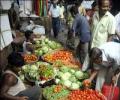
The rise in May Wholesale Price Index based inflation has been mainly on account of 31.44 per cent increase in prices of potato, 19.40 per cent in fruits and 12.75 per cent in rice.

This could be the reason why Prime Minister Narendra Modi mentioned tomato, onion, and potato as his government's 'TOP' priority, in an election rally on February 5 in poll-bound Karnataka.

The Reserve Bank of India, which mainly factors in retail inflation to decide its monetary policy, has been tasked by the government to ensure the rate of price rise remains around 4 per cent.

While the farmers are not getting remunerative prices for their produce, at the same time they are forced to pay high prices for items they consume.
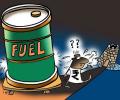
The wholesale price-based inflation accelerated to a record high of 12.94 per cent in May, on rising prices of crude oil and manufactured goods. Low base effect also contributed to the spike in WPI inflation in May 2021. In May 2020, WPI inflation was at (-) 3.37 per cent. This is the fifth straight month of uptick seen in the wholesale price index (WPI)-based inflation. In April, 2021, WPI inflation hit double digit at 10.49 per cent. "The annual rate of inflation, based on monthly WPI, was 12.94 per cent for the month of May, 2021 (over May, 2020) as compared to (-) 3.37 per cent in May 2020.
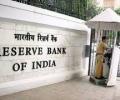
CLSA says government actions to facilitate investment more important for revival than a token monetary easing.
High oil prices are expected to push up inflation to 3.9 per cent in the next three months, hardening interest rates, economic think-tank IEG has said.

'The economy is suffering (perhaps 'enjoying' is a better word) the lowest credit demand in decades; banks are struggling with stressed loans equivalent to near 10 per cent of GDP,' points out Devangshu Datta.

Consumer prices rose an annual 5.11 per cent (2012 base) in January.

RBI Governor Raghuram Rajan will announce the monetary policy on April 1 and expectations of a status quo are rising ever since the official data on consumer price inflation for February pointed to a cool down to 8.1 per cent.

While India won't be immune to global spillovers, we need to create the macro preconditions for sustained growth. Policy agility, prudence, and resilience will be key, suggests Sonal Varma.

The retail inflation rate breached the 6 per cent upper tolerance limit of the RBI for the first time in seven months in January, while the wholesale price index stayed in double-digits for the 10th month in a row, showed two sets of data released by the government on Monday. Retail inflation, the key input for the RBI while reviewing the repo rate every two months, soared during the month mainly because of a spike in certain food items. The previous high for retail inflation was 6.26 per cent in June 2021.

India's wholesale prices declined at a faster-than-expected annual rate of 2.33 per cent in March.
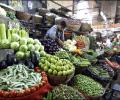
Wholesale fuel prices in May fell 10.51 per cent year-on-year.

Monetary Policy- Easing expected to happen later this financial year.

Food prices, which have contributed to a large part of inflation over recent years, have remained benign, despite unseasonal rain.

The poor performance of capital goods - a bellwether for future growth - has alarmed most analysts

The Monetary Policy Committee (MPC) is expected to maintain the status quo on policy rates for the fourth consecutive time in its October 4-6 review meeting. The incremental information available since its last meeting in August suggests that growth and inflation prints for the second quarter (Q2) of financial year 2023-24 (FY24) will exceed the committee's projections. However, the Consumer Price Index (CPI)-based inflation is expected to moderate in the second half (H2) of FY24.

India's services sector lost momentum in July as demand was curtailed by competitive pressures, elevated inflation and unfavourable weather, a monthly survey said on Wednesday. The seasonally adjusted S&P Global India Services PMI Business Activity Index fell from 59.2 in June to 55.5 in July, pointing to the slowest rate of growth in four months. For the 12th straight month, the services sector witnessed an expansion in output. In Purchasing Managers' Index (PMI) parlance, a print above 50 means expansion while a score below 50 denotes contraction.

The rate of price rise in the protein rich items like eggs, milk and other products too moderated in March as against the previous month.

Growth in China's consumer inflation slowed than market expectation to 1.6 per cent in September, the lowest since January 2010, according to the official data released on Wednesday.
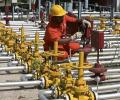
Gail India subsidiary Mahanagar Gas (MGL) on Friday announced a steep reduction in the retail price of compressed natural gas (CNG) by Rs 8/kg and domestic PNG (piped natural gas) by Rs 5/SCM across its licenced area. The move comes on the heels of the Centre revising the pricing methodology of domestically-produced natural gas on Thursday as proposed by the Kirit Parikh committee and following it with the new price announcement earlier in the day. In February, the city gas distributor reduced its CNG price by Rs 2.5/kg but prices are still around 80 per cent more than those in April last.

The rate of price rise in the food basket contracted by 0.86 per cent in October compared to 0.51 per cent rise in September

A Kotak research report expects RBI to cuts rates by 50 basis points in the first half of 2019. RBI will announce its sixth bi-monthly monetary policy on February 7.

'Over the next 12 months, it will be difficult to make 15 to 20 per cent return in the markets as the valuations appear stretched.'

The Wholesale Price Index-based inflation was (-)4.54% in Sep.
 © 2026 Rediff.com - Advertise with us - Disclaimer - Privacy Policy - Sitemap - Feedback - About us - Terms of use - Grievances